Mount Everest 8850 meter (29035 ft) Nepal/China is the tallest mountain.
The sunrays reached at the earth in 8 minutes & 3 seconds.
Only 11 percent of the earth's surface is used to grow food.
The coldest temperature ever measured on Earth was -129 Fahrenheit (-89 Celsius) at Vostok, Antarctica, on July 21, 1983.
About 70% of the world’s fresh water is stored as glacial ice.
Only 3% water of the earth is fresh, rest 97% salted. Of that 3%, over 2% is frozen in ice sheets and glaciers. Means less than 1% fresh water is found in lakes, rivers and underground.
The warmest sea in the world is the Red Sea, where temperatures range from 68 degrees to 87.8 degrees F depending upon which part you measure.
The hottest planet in the solar system is Venus, with an estimated surface temperature of 864 F (462 C).
Angel Falls in Venezuela is the worlds highest waterfall, The water of Falls drops 3,212 feet (979 meters).
Asia Continent is covered 30% of the total earth land area, but represent 60% of the world’s population.
The total surface area of the Earth is 197 million square miles.
El Azizia in Libya recorded a temperature of 136 degrees Fahrenheit (57.8 Celsius) on Sept. 13, 1922 - the hottest ever measured.
A 1960 Chilean earthquake was the strongest earthquake in recent times, which occurred off the coast, had a magnitude of 9.6 and broke a fault more than 1000 miles (1600 kilometers) long.
Showing posts with label Fact Of The Day. Show all posts
Showing posts with label Fact Of The Day. Show all posts
Thursday, January 1, 2009

Sunday, December 28, 2008
Longest Glaciers
Basically a glacier is a slow moving mass of ice and what better place to find a slow moving mass of ice than the frozen wastelands in Antarctica.
The world's longest glacier is the Lambert-Fisher glacier at an icy 320 miles in length and a not-so-hot 25 miles in width.
The Lambert-Fisher glacier is a speed demon as far as slow moving masses of ice go, moving over a half mile each year.
Deep sea trenches
Any long, narrow, steep-sided depression in the ocean bottom in which maximum oceanic depths (approximately 7,300 to more than 11,000 m [24,000 to 36,000 feet]) occur. The deepest known depression of this kind is the Mariana Trench, which lies east of the Mariana Islands in the western North Pacific Ocean.The Mariana Trench is located in the Pacific Ocean, just east of the 14 Mariana Islands (11"21' North latitude and 142" 12' East longitude ) near Japan. As you probably already know, it is the deepest part of the earth's oceans, and the deepest location of the earth itself. It was created by ocean-to-ocean subduction, a phenomena in which a plate topped by oceanic crust is subducted beneath another plate topped by oceanic crust. 


Sunday, November 23, 2008
Rivers,Waterfalls and Lakes

The source of the Nile was discovered by Europeans in 1858 when British explorer John Hanning Speke reached Lake Victoria Nyanza, in what is now Burundi. Almost a hundreds year later , in 1953, the source of the Amazon was identified as a stream called Huarco flowing from the Misuie.But geographers do not consider the entire route to be part of the Amazon basin, so the Nile, with an overall length of 6695 km, is considered the world,s longest river.
Monday, November 3, 2008
Geysers

Geysers are jets of boiling water and steam that erupt from beneath the ground where water is heated by volcanic activity. The name geysers comes from a hot spring called Geysir at Haukadalur ,Iceland. Yellowstone National Park,Wyoming, USA has more geysers than anywhere else. There are 500 active ones including Steamboat geyser, which erupts to a height of 120m and old faithful geyser which erupts about every 91 minute.
Largest Islands

The largest island in the world is Greenland.An a island is a piece of land surrounded by water. Australia is so large it is continent, not a island; otherwise it would rank first. The largest US island is Hawaii, which measures 10.456sqkm, and the largest off mainland USA is Kodiak,Alaska, at 9.510sqkm. The smallest island with country status is Pitcairn, at just4.53sqkm.
Monday, October 20, 2008
FOTD(Longest Mountain Range)
A mountain range is a continuous chain of mountains---a mountain is land that rises 300m or more above it's surrounding.
Range---------------------------Location-------Approx length(km)
Range---------------------------Location-------Approx length(km)
- Andes--------------------South America----7242
- Rocky Mountains-----------North America---6035
- Himalayas -----------------Asia ------------ 3862
- Great Dividing Range ------Australia---------3621
- Trans-Antarctic Mountains-Antarctica -------3541
Saturday, October 18, 2008
FOTD(Largest Deserts)
Deserts cover one fourth of the Earth's land surface. They range from extremely arid and barren sandy deserts ,through arid to semi-arid. Most deserts have features of all these, with one zone merging into the next , so the start and finish of any desert is not exact. Many of the world,s largest deserts are broken down by geographers into smaller desert regions-the Australian Desert includes the Gibson, Great sandy, Great Victoria and Simpson, for example.
Desert----------------------------Location---------------------Approx area (sq km)
Desert----------------------------Location---------------------Approx area (sq km)
- Sahara--------------------North Africa-------------------9100000
- Australian----------------Australia-----------------------3400000
- Arabian Peninsula------Southwest Asia-----------------2600000
- Turkestan----------------Central Asia--------------------1900000
- Gobi-----------------------Central Asia--------------------1300000
- North American Desert--US/Mexico---------------------1300000
Thursday, October 16, 2008
FOTD(The Highest Mountain)
The height of mountains is usually measured from sea level. Hawaii's tallest, Mauna Kea, is only 4,245m above sea level, but rises a total of 10,203 from the flour of Pacific Ocean, making its overall height 1,353m greater than Mt. Everest.
Wednesday, October 15, 2008
FOTD(Uluru)

The rock formerly known as Ayers Rock, Northern Territory, Australia, is believed to be the world's largest free-standing rock. It is made of sandstone and measures 335m high, 3.6 km long and 2 km wide. It was originally called after South Australian premier Sir Henry Ayers, but it is now known by the name given to it by local Aborigines, to whom it is scared.
Monday, October 13, 2008
FOTD(Giant Meteorites)
About 500 meteorites reach earth every year. Many fall in the sea and in unpopulated areas and are never seen. The Hoba meteorite,the largest in the world, was found in Namibia in 1920. It measures 2.73 multiplied 2.4m and is 82 percent iron and 16 percent nickel. It weights more than 60 tonnes. Second largest is the Tent, found in Greenland in 1894 and now known by it's original Eskimo name, Ahnighito. This meteorite weighs about 57.3 tonnes and is on displayed in the New York museum of natural history.
Sunday, October 12, 2008
FOTD(Longest Space Walk)
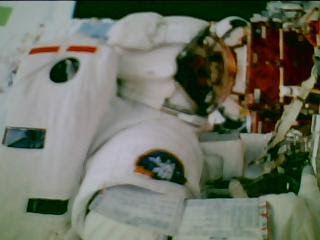
The record for the longest-ever spacewalk was broken from 10-11 March 2001, when mission specialists James Voss and Susan Helms stepped outside space shuttle Discovery STS-102 to do construction work on the space station. Their EVA lasted 8 hours 56 minutes.
Saturday, October 11, 2008
FOTD(First Telescopes)

The first telescopes were made in 1608by Dutch optician Hans Lippershey. Italian astronomer Galileo built his own soon after and use it to discover Jupiter's moon. The earliest type of telescope, known as a refracting telescope, produced a slight distortion of images. Since about 1670, astronomers have preferred to use reflecting telescopes, which use mirrors that compensate for the distortion.
Friday, October 10, 2008
FOTD(One And Only)
The only human remains on the Moon are those of geologist Eugene Shoemaker who was an expert on planetary collisions. His ashes were carried abroad NASA's Lunar Prospector spacecraft, which was crashed into a crater on 31 July 1999 .
Tuesday, October 7, 2008
FOTD(Is There A Tenth Planet)

Astronomers think they have discovered another planet .In 2005 Palomar observatory ,U.S.A, spotted a rocky object in the most distant part of the Solar system. It's official name is 2003 UB313 but it has been nick named as Xena. The planet might be 3000 km in diameter , which is larger than Pluto. It has at least one moon.
Monday, October 6, 2008
FOTD(Light Years)
A light year measures distance, not time.Distances in space are often described as light years , the distance light travels in a year.
Body | Light reaches Earth In
Moon - 1.26seconds
Sun- 8 minutes 17 seconds
Pluto- 5 hours 20 minutes
Nearest star- 4.22 years
Distance at which the sun
is not visible to us- 60 years
Most distant star in our galaxy-62,700 years
From nearest body outside our
galaxy- 174,ooo years
Furthest visible star- 2,309,000 years
Most distant known quasar- 14,000,000,000 years
Body | Light reaches Earth In
Moon - 1.26seconds
Sun- 8 minutes 17 seconds
Pluto- 5 hours 20 minutes
Nearest star- 4.22 years
Distance at which the sun
is not visible to us- 60 years
Most distant star in our galaxy-62,700 years
From nearest body outside our
galaxy- 174,ooo years
Furthest visible star- 2,309,000 years
Most distant known quasar- 14,000,000,000 years
Saturday, October 4, 2008
FOTD(Just A Second)
A second does not sound very long, but by the time you have read this sentence, almost five of them will have gone by.Watch an average-length film and more than 5,000 seconds will tick away,In a lifetime of 80 years there are more than 2.5 billion seconds - but you will spend more than 800 million of them asleep!
Period Seconds
1 minute 60
1 hour 3,600
1 day 86,400
1 week 604,800
1 year 31,536,000
Period Seconds
1 minute 60
1 hour 3,600
1 day 86,400
1 week 604,800
1 year 31,536,000
Friday, October 3, 2008
FOTD(The World In A Single Day)
Did you know that in one day (24 hours or114o minutes or 86,400 seconds) the world turns once on its axis.During that time, on average;
- 358,522 people are born
- 115,012 people died
- 203,510 are added to the world,s population
FOTD(Time Piramid)

The Mayan pyramid Chichen Itza, Mexico , built around 1050 has four stairways, each with 91 steps , and one platform.This makes a total 365,the number of days in a year.The stairways, also divide the nine terraces of each side of the pyramid into 18 segments, representing the 18 months of the Mayan calender.
Thursday, October 2, 2008
Fact Of The Day: Leap Seconds
Today's Fact Of The Day (FOTD) is Leap Seconds:
The rotation of the Earth is slowing down.This means that a solar day(the time it takes Earth to make one complete revolution)and the time shown by atomic clocks would gradually diverge. This problem has been solved by "leap seconds" . There have been 22 leap seconds since 1972. The last one was added on 31 December 2005 , which delayed new year's day 2006 by one second!
The rotation of the Earth is slowing down.This means that a solar day(the time it takes Earth to make one complete revolution)and the time shown by atomic clocks would gradually diverge. This problem has been solved by "leap seconds" . There have been 22 leap seconds since 1972. The last one was added on 31 December 2005 , which delayed new year's day 2006 by one second!
Subscribe to:
Posts (Atom)